Breathwork in Stockholm: What to Expect (and How to Choose the Right Guide)
Breathwork has grown enormously in recent years. And with that comes everything from five-minute breathing exercises and nervous system practices to conscious connected breathing, emotional processing and journeys into altered states of awareness.
They can all be called Breathwork. But they are not the same experience.
So if you're looking for Breathwork in Stockholm, I think the question isn't only where can I do Breathwork?
It's also: What kind of experience am I looking for — and who do I want beside me while I explore it?
My own work sits somewhere between the physiological and the harder-to-name. My training spans Breathwork, breathing physiology, nervous system awareness, Reiki, meditation, and coaching, and those different perspectives shape how I work. I'm equally curious about what isn't so easily explained — energy, consciousness and what can emerge when the thinking mind doesn't have to lead for a while.
I primarily work with conscious connected breathing, where the breath becomes continuous and rhythmic. It can be powerful, but I don't believe powerful has to mean forceful. There is no prize for breathing harder, releasing more or having the most dramatic experience in the room.
Some sessions are emotional. Some are deeply physical. Some feel energetic or spiritual. Some are quiet. Sometimes very little seems to happen until you realise afterwards that something has shifted.
My role isn't to decide what your experience should be.
It's to create the conditions in which you can safely become curious about what is already there.
That is the foundation of Breathwork for the Inner Realms — my way of bringing together conscious connected Breathwork, nervous system awareness, somatic experience, Reiki and energy work, meditation and intuitive guidance.
Not because every experience needs to be explained, fixed or transformed.
Sometimes we simply need enough space to meet ourselves differently.
Breathwork for the Inner Realms: Science, Energy & Intuition
I call my approach Breathwork for the Inner Realms because I'm interested in more than the breath itself. Each session is an exploration of what is present that day — in the body, the emotional landscape, the sky, the energy and the parts of ourselves we don't always reach through thinking alone.
Depending on the session, I may weave together:
Conscious connected Breathwork with gentler breathing practices
Nervous system awareness and somatic exploration
Reiki and energy work
Emotional processing and embodied presence
Meditation and guided inner journeys
Intuitive guidance, sometimes including Tarot
Seasonal themes and astrological influences
Not every session contains all of these elements. I work intuitively with what is present rather than following one rigid formula.
The themes of my group journeys often change with the season, the astrological landscape or something I'm sensing within the collective. In private sessions, the work can become more individual — shaped by what you arrive with and what emerges as we work together.
For me, this is where science and intuition don't need to compete. I can understand something about breathing physiology and the nervous system while still leaving room for energy, symbolism, emotion, consciousness and experiences we may not have a neat explanation for.

“I work in the spaces science can’t measure—where the body remembers and energy moves. Where the breath meets the unseen—and the nervous system exhales its truth.” - Kia
What Happens in a Breathwork Session With Kia?
There is a structure to the way I hold Breathwork, but there is no predetermined experience you are supposed to have.
We usually begin by arriving. Noticing where you are that day, what is present in the body, and perhaps setting an intention — not as something you need to achieve, but as a direction for the journey.
From there, I guide you into conscious connected breathing: a continuous, rhythmic breath without pauses between the inhale and exhale. As the breathing develops, the experience can shift. You may notice physical sensations, emotion, memories, imagery, energy or changes in your state of awareness. Or your experience may be much quieter than that. Depending on person and/or group, we might go in to deeper guidance to other realms.
I use music, verbal guidance and somatic cues throughout the journey, but I don't constantly tell you what you should be feeling or where you should go. I don't want to lead you towards an experience I've already decided you need to have.
Sometimes I may invite you to notice a sensation, meet an emotion, explore an image or become curious about what is emerging. Sometimes the most useful thing I can do is say less and let the breath lead.
Reiki and energy work are also part of how I hold the space. Depending on the session, I may work energetically while you breathe, and towards the end we gradually allow the active breathing to settle into stillness and integration.
And this part matters to me: a powerful Breathwork session doesn't have to look dramatic to be transformative or profound.
You don't need to cry, shake, have a breakthrough or leave with an answer. Sometimes something moves. Sometimes something becomes clearer. Sometimes you simply experience yourself differently for a while. Sometimes you feel You and your own aliveness.
The work isn't about performing transformation.
It's about creating enough space to notice what is there.

Kia holds Breathwork & Energy session in Stockholm at Studio Hember, Döbelnsgatan 12a, and Online sessions. Group sessions as well as 1:1.
What Is Breathwork? (And Why It Matters Now)
Breathwork is the conscious use of your breath to shift your physical, mental, emotional, or energetic state. Unlike everyday deep breathing, breathwork practices allow you to influence your nervous system, access emotional release, and regulate internal patterns. It can be gentle or activating, still or dynamic, depending on the technique.
Most of us breathe only enough to survive, not to thrive. We use a fraction of our lung capacity and unconsciously reinforce stress patterns through shallow, upper-chest breathing. Breathwork interrupts these loops. It invites a fuller, more embodied way of living—by first restoring how we breathe.
Conscious connected breathing is a style of Breathwork where the inhale and exhale are linked in a continuous rhythm, without the natural pauses we usually have between breaths.
Unlike calming breathing practices that are often used specifically to settle the system, conscious connected breathing can be more activating. As the breathing pattern changes, so can sensations in the body, attention, emotion and perception.
And this is where I think some nuance is important.
Breathwork is sometimes described as if the breath simply “releases stored trauma” or as if every physical sensation has a specific emotional meaning. I don't work solely from that assumption. The body is more complex than that, and not everything that happens during Breathwork needs a story attached to it.
At the same time, conscious connected breathing can create experiences that feel profoundly emotional, embodied or energetic. People may encounter grief, joy, resistance, memories, imagery, unexpected insight — or simply a very different sense of being in their body.
Part of my work as a facilitator is knowing enough about the physiology not to mistake every sensation for something mystical, while also leaving room for experiences that aren't easily reduced to physiology alone.
Is Conscious Connected Breathwork the Same as Holotropic Breathwork?
Not exactly. They share some characteristics — particularly continuous breathing, music and the possibility of entering non-ordinary states of awareness — but Holotropic Breathwork is a specific method developed by Stanislav and Christina Grof, with its own framework and facilitation model.
The Breathwork I facilitate draws primarily on conscious connected breathing and my broader training and experience in Breathwork, nervous system awareness, Reiki, hypnotherapy, meditation, energy and somatic work.
I don't call my sessions Holotropic Breathwork.
That distinction matters, particularly now that many different practices are grouped together under the word Breathwork.
My sessions are called Breathwork for The Inner Realms.
Is Breathwork Safe?
For most healthy adults, Breathwork can be practised safely, but not every breathing practice is appropriate for every person — and more intensity is not necessarily better.
More active styles of breathing can create significant physiological changes and strong physical or emotional sensations. Tingling, temperature changes, light-headedness, muscle tension or cramping can occur, particularly with more activating breathing.
This is one reason I don't teach Breathwork as something to push through.
During my sessions, you are always free to slow the breath, change the breathing pattern, return to your natural breath, move your body, rest or stop altogether. Your body doesn't have to keep up with the room.
There are also circumstances where activating Breathwork may not be appropriate, or where adaptations are needed. I therefore ask participants to review the health considerations before joining a session and to speak with me if they are unsure.
I also distinguish between intensity and depth. A session doesn't become more therapeutic or transformative simply because the breathing is stronger or the experience more dramatic.
Sometimes the deeper work happens when we soften.
For a fuller look at contraindications, common physical responses and what actually happens during more activating breathing, you can read Is Breathwork Safe? What Science, Therapists & Experience Say
Why Do People Come to Breathwork?
People arrive at Breathwork for very different reasons.
Some come because they feel stressed, restless or constantly switched on. Others feel stuck in their head and want a way of working that doesn't begin and end with thinking. Some are navigating change, grief, relationships or old patterns. And some aren't trying to solve anything at all — they're curious about consciousness, energy, creativity or what becomes available when they meet themselves through the body rather than the mind.
Breathwork can offer a different doorway into all of this and it can support you in ways both subtle and profound. Whether you're processing something specific or just craving more vitality, people often report:
Clarity and mental focus – Stepping out of constant thinking and into the body can create more space for perspective, insight and choice.
Emotional processing – Breathwork can bring emotions closer to the surface and create space to experience them without immediately needing to analyse or explain them.
Confidence and self-trust – Meeting your own responses, boundaries and emotions through the body can deepen your sense of trust in yourself.
Stress and anxiety relief – Certain breathing practices can support nervous system regulation and help shift how stress is experienced in the body.
Physical relaxation and sleep – Gentler breathing practices in particular can support relaxation and settling, which may also support sleep.
Energy and inner connection – You may experience greater vitality, presence or connection to your intuition and inner world.
And perhaps most importantly: a feeling of coming home to yourself.
Research into breathing practices suggests that certain forms of Breathwork may support stress reduction, emotional regulation and wellbeing. But Breathwork isn't one single technique, and the evidence is stronger for some breathing practices and outcomes than others.
With conscious connected breathing, I think it's useful to hold both what we know and what people experience.
Focus, Clarity & Presence
We live with an extraordinary amount of stimulation. Attention is constantly being pulled somewhere else, and it can become surprisingly difficult to simply be where we are.
Working consciously with the breath can bring attention back into the body and the present moment. Sometimes that creates a sense of clarity. Sometimes it helps us notice the difference between reacting automatically and having enough space to choose our response.
For people who spend much of their lives thinking, analysing, creating, leading or making decisions, that shift can be valuable in itself.
Not because Breathwork magically makes you more productive — but because clarity often becomes easier when there is a little less noise.
Energy & Emotional Experience
Breathwork can also bring us into closer contact with emotion.
You may become aware of sadness beneath irritation, exhaustion beneath constant doing, or tension you hadn't noticed until you stopped. Emotion may arise without an obvious story attached to it. And sometimes what you notice is simply energy — tingling, warmth, movement, expansion, contraction or a sense of aliveness.
I don't assume that every sensation means an emotion has been “stored” somewhere in the body, or that everything that arises needs to be released.
But I do think there is something powerful about being able to experience an emotion without immediately having to explain it.
The breath can give us somewhere to stay while something is being felt.
If you're curious about working specifically with difficult emotions, you can read more in [Breathwork for Anger, Frustration & Grief →].
Altered States: Beyond the Thinking Mind
This is also one of the reasons I'm personally so fascinated by conscious connected Breathwork.
More activating breathing practices can sometimes lead to changes in perception and non-ordinary states of awareness. The usual thinking mind may become quieter or operate differently, and people can experience imagery, unexpected insight, emotion, creativity, a sense of connection or experiences they describe as spiritual.
Not everyone does. And I don't think an altered state should be the goal of every session.
But when it happens, I'm interested in what becomes available when we aren't trying to think our way to the answer.
This isn't escapism. If anything, I see it as the opposite — a way of coming more fully into the experience of being here. Not through logic alone, but through the body, emotion, sensation, energy and whatever else may emerge.
An altered state isn't automatically healing, profound or meaningful simply because it's unusual. What interests me is what it may allow us to notice — and what we bring back with us when the experience is over.
For me, this is where Breathwork becomes particularly interesting: at the meeting point between physiology, consciousness and the parts of human experience we still don't fully understand.
A session may leave you calmer or clearer. It may bring emotion closer to the surface. You might notice something you've been avoiding, experience a shift in perspective or feel deeply connected to yourself.
And sometimes it isn't comfortable.
I don't see the purpose of Breathwork as making you feel good all the time. We don't have to feel good to be deeply alive. For me, the value is often in creating enough space to meet more of our experience without immediately needing to change it.
If you're interested in the research and broader physical and psychological effects of breathing practices, I've explored this in more depth in 17 Benefits of Breathwork: Science, Nervous System & More
Who Is Breathwork For?
You don’t need to be burned out or spiritual to benefit from breathwork. It’s for anyone who wants to:
Feel more at home in their body
Break free from stress or looping thoughts
Reconnect with their emotional truth
Enhance clarity, energy, and creativity
Explore their inner landscape with curiosity and care
Breathwork can be a powerful complement to therapy or in combination with coaching. If you’re navigating change or if you’re simply curious - this might be your invitation in.
Your breath and brain are in constant conversation. Each inhale and exhale sends signals to the nervous system, which shapes your heart rate, emotional tone, stress response, and even cognitive function. If you would like to read more about the science of breath and how your breath rewires the brain, go here.

Breathwork can open up for new space, clarity and heart felt vibrations.
“As soon as I stepped into the door it felt like coming Home. Thank you❤️”

Breathwork Stockholm with Reiki and Tarot - Kia Agerhem
Meet Kia Agerhem – Your Breathwork Guide in Stockholm
With over 20 years of experience spanning the business world, yoga, meditation and inner work - later expanding into Breathwork, Reiki and energy work — Kia brings together a broad range of perspectives in the spaces she creates.
Certified breathwork guide
Trauma-informed, Intuitive and Safe
Reiki Master Teacher, energy coach & intuitive
Certified within meditation, somatic healing & Shamanic Journeying
Fluent in English & Swedish
"You don’t have to fix yourself—you just need to meet yourself. That’s where the shift begins."
Kia holds Breathwork sessions in Stockholm, primarily in Vasastan at Studio Hember, Döbelnsgatan 12A, as well as selected studios and spaces around the city. She also work with groups, private sessions and private groups, and also offer Breathwork online.
No previous experience is needed. Curiosity is enough.
Practical Info: Breathwork Sessions in Stockholm
📍 Location: Studio Hember, Vasastan
🧘♀️ Group and 1:1 sessions available
🌍 Online sessions and courses also offered
🌙 Themes shift with the universe or intuitive guidance—sometimes by request or a longing
🤍 Bring comfortable clothes and an open mind
👶 Pregnant or sensitive? Let Kia know - modifications are welcome
Ready to Try Breath Work in Stockholm?
Kia offers in-person breathwork sessions in Stockholm, as well as online journeys and group courses. Whether you’re new or experienced, each session is designed to guide you deeper into your own intelligence, body, and breath.
👉 Explore upcoming sessions
👉 Join a 10-day online course
👉 Book a 1:1 breathwork & Reiki session
Let your breath take you where your mind can’t go.
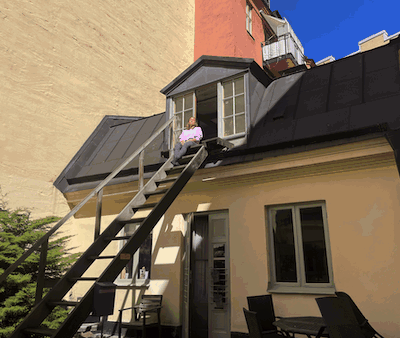
The old Breathwork studio: the Loft, Stockholm. Now replaced by Studio Hembe, meaning “home”
Frequently Asked Questions About Breathwork in Stockholm
What is the difference between breathwork and deep breathing?
Breathwork is a structured, intentional practice that uses specific breathing patterns to influence your physical, emotional, mental and energetic state. Unlike casual deep breathing, breathwork can support a profound release of tension from the physical and emotional body, the mind or the energetic self, assist in nervous system regulation, and altered states of consciousness.
Is breathwork safe for everyone?
Breathwork is generally safe, but certain techniques may need modifications during pregnancy, acute mental health crises, or for individuals with cardiovascular issues. Kia is trauma-informed and adapted to meet your needs. You’ll be guided gently, and you will feel safe. Always let your guide know about any concerns beforehand.
Do I need experience with meditation or yoga to try breathwork?
Not at all. No prior experience is required. Whether you’re completely new or already familiar with mindfulness practices, breathwork meets you where you are—through gentle energetic shifts or deep, full-body release, depending on what your system is ready for.
What happens in a breathwork session with Kia Agerhem?
You’ll be guided through a supportive experience that includes grounding, an active breathwork journey, and gentle integration. My sessions blend breathing physiology and nervous system awareness with energy work and intuitive presence. The full session usually lasts 75–120 minutes, depending on group or private setting.
Can I do breathwork online or only in Stockholm?
Both! Kia offers in-person sessions in Vasastan, Stockholm, as well as online sessions, courses, and programs. You can explore your breath and energy whether you're local or tuning in from afar. Kia also facilitates sessions at studios such as Moumo and other wellness spaces around the city.
Why Breathwork with Kia Agerhem?
Kia brings over two decades of experience in energy work, coaching, breathwork, meditation, yoga, personal transformation and inner work. She is trauma-informed and her sessions deeply intuitive—rooted in both modern science, physiology and the subtler aspects of human experience.
You’ll be held in a space that’s not about performance - but about presence. Kia meets you exactly where you are, helping you safely explore your inner landscape and return to a deeper sense of self.
Kia is known for her presence. For the voice that softens the noise. For the space she creates that feels like exhale.
Her work isn’t just about technique - it’s about inner alchemy. That subtle shift that can’t always be explained, but is felt. In your breath. In your body. In the way you meet yourself.
With Kia, you’re not asked to perform or fix yourself. You’re invited to meet yourself - gently, powerfully, in your own time and in your way.
Where are your Breathwork sessions in Stockholm?
I hold my longer Breathwork & Energy journeys, both group and 1:1 sessions, at Studio Hember, Döbelnsgatan 12A in Vasastan. I also offer open Breathwork sessions at Moumo in Södermalm and occasionally at other spaces around Stockholm.
I also hold a monthly online Breathwork session, which is included in The Field — a weekly space to tend to your inner life.